How to Try a Fragrance Without Buying the First One
The first spray tells you the least. A four-day sampling plan that moves from paper strips to skin, so you choose the scent you will actually live with.

The first spray at a perfume counter is the least representative moment in a fragrance’s life. It is mostly alcohol and the lightest, brightest materials in the formula, and it is gone within minutes. Buying on that impression is like choosing a film from its opening credits.
A better approach costs nothing but a few days. The plan below spreads the decision across four short sessions, so that what you finally pay for is the scent you will actually be living with at 3 p.m., not the one that flattered you for ninety seconds.
Why a single sniff misleads
Two things work against a quick decision. The first is the way a perfume unfolds. The Perfume Society describes a pyramid: light top notes that are noticed first, heart notes that develop after ten to fifteen minutes, and base notes that slow evaporation and last longest. Its guide to finding a new fragrance notes that top notes can disappear within the first few minutes of spraying, and that an hour on skin is enough to judge how a scent really smells on you.
The second is your own nose. Smell adapts quickly: a 2017 review in Physiology & Behavior describes the decline in perceived intensity with repeated exposure to an odor as relatively fast. After several heavy sprays in a row, you are no longer comparing like with like.
You are not choosing the first five minutes. You are choosing the fourth hour.
The four-day plan
Day 1: paper only, and a shortlist
Go to the counter with clean, unscented wrists and no intention of buying. Ask for paper blotters and spray each candidate on its own strip.
- Write the name on every strip before you spray. An unlabeled stack is useless within ten minutes.
- Wait a moment before smelling so the first rush of alcohol can lift, then hold the strip a little away from your nose.
- Keep the number small. Four or five strips is plenty for one visit.
- Sort as you go into yes, maybe and no. Put the no strips down and walk away from them.
Paper is a filter, not a verdict. The Perfume Society’s FAQ is blunt that blotters are useful for narrowing choices but are not enough to base a purchase on, because they show only the initial impression. Leave with two or three names, and ask for samples of them if the store offers any. Take the labeled strips home in separate pockets and smell them again that evening; some will have become more interesting, some will have gone flat.
Day 2: one fragrance, on skin, all day
Pick the strongest candidate and wear it alone. One spray on the inner wrist or forearm is enough for a test. Skip other scented products nearby, such as a perfumed hand cream, so you know what you are smelling.
Then check in on a schedule and jot down a word or two each time:
- Right away. The opening. Note it, but give it the least weight.
- At about 20 minutes. The heart is arriving. Is it still something you like?
- At one hour. This is the scent in its settled form.
- At three to four hours. What is left? Is it pleasant, faint, or irritatingly present?
You may notice that you stop smelling it altogether after a while. That is your nose getting used to it rather than the fragrance vanishing; other people may still be able to smell it. Bring your wrist up for a deliberate sniff rather than judging by what drifts past.
Day 3: the second candidate, same conditions
Repeat exactly, with fragrance number two. Same amount, same spot, same check-in times. Keeping the routine identical is what makes your notes comparable.
If you are short on days, the Perfume Society suggests that one fragrance per wrist is workable, and advises never trying more than three on skin at once. Two on separate wrists is the honest limit for a real comparison, and only if you keep your arms apart.
Day 4: retest the favorite in a different setting
Wear the front-runner again, but change the context: a different time of day, different weather, after a workout or before dinner. Mood, weather and even food can shift how a scent comes across, which is why the same guide recommends coming back to each one a couple of times.
If it still pleases you on a second, different day, you have your answer. If your enthusiasm has dropped, that is useful too, and you have lost nothing.
What to write down
Notes do not need perfumery language. Three plain questions are enough:
- Did I like it more or less as the hours went on?
- Was it ever too much, for me or for a small room?
- Did I want to smell it again, or was I relieved when it faded?
If you would like better words for what you noticed, our guide to describing scents at a perfume counter gives you a working vocabulary.
Habits that keep the test fair
Give your nose breaks. When everything starts to smell the same, stop. Step outside for a few minutes rather than pushing on. Jars of coffee beans are a familiar counter custom, but they are a custom rather than an established fix; a pause is the simpler option.
Try the concentration you plan to buy. An eau de toilette and an eau de parfum with the same name are not always the same scent at different volumes. Our piece on eau de toilette and eau de parfum explains why.
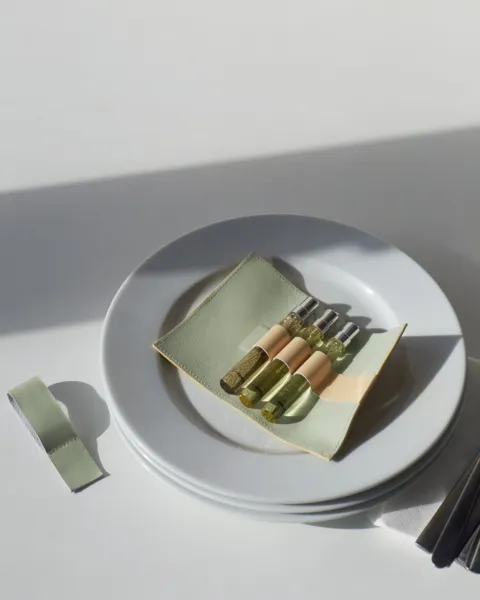
Start small. If a travel size or discovery set exists, it lets you extend the trial for weeks before committing to a full bottle. It also fits neatly into a small fragrance wardrobe.
When the answer is “none of them”
Sometimes the four days end without a winner. That is a successful result: you have learned which directions do not suit you, and that narrows the next shortlist. The plan works the same way the second time around, and it is faster once you know what you are ruling out.
Sources
- The Perfume Society FAQs - The Perfume Society
- The Perfume Society 3 steps to finding your perfect perfume…
- Physiology & Behavior (record at Wageningen University & Research) Habituation and adaptation to odors in humans
- DermNet Fragrance allergy
Researched and written by Dates Force Editorial with AI assistance, from the published sources listed above — not from product testing. This is general information about everyday cosmetic care, not medical advice. How we work · Report an error
Part of The Weekend Edit
Keep reading
Eau de Toilette and Eau de Parfum: Reading Beyond the Name
The names point to concentration, but no fixed percentage stands behind them. What the label can and cannot tell you, and how to compare two versions on skin.