Skin prep has grown into a category of its own: mists, essences, masks, primers, tools, sometimes six or seven layers before any makeup is opened. Most of it is optional, and a good share of it works against the makeup that follows. Base products sit best on skin that is clean, comfortable and not coated in anything still wet.
That takes three products and roughly ten minutes, most of which is waiting.
The prep, in order
1. Start with a clean face
Wash with a gentle cleanser, lukewarm water and your fingertips, then pat dry. That is the American Academy of Dermatology’s basic face-washing method, and it clears away anything left from the night before so you are not layering over it.
Time: one minute.
2. Moisturize, thinly
Apply moisturizer while your skin is still slightly damp; the AAD notes that this helps hold water in the skin. Use the texture that suits you. In the AAD’s moisturizer guide, gels are the lightest, then lotions, then creams. Skin that gets oily may only want moisturizer on the drier areas.
Before makeup, less is more useful than more. A thin, even layer that sinks in gives foundation something to glide over. A thick one that sits on the surface gives it something to slide off.
Time: thirty seconds to apply, then a minute or two to settle.
3. Sunscreen
In the AAD’s order of application, sunscreen goes on after moisturizer and before makeup. The specification is broad-spectrum, SPF 30 or higher. Apply the full amount; the AAD suggests at least a teaspoon for the face.
A moisturizer with broad-spectrum SPF 30 or higher can merge steps two and three, which also removes one layer from under your base.
Time: thirty seconds to apply.
4. Wait
This is the step people skip, and it is the one that most affects how makeup goes on. The AAD says sunscreen takes about 15 minutes to absorb. You do not have to stand still for that long, but give it as much of that as your morning allows: get dressed, do your hair, have breakfast. When your skin no longer feels slippery, it is ready.
Time: five minutes or more, hands off.
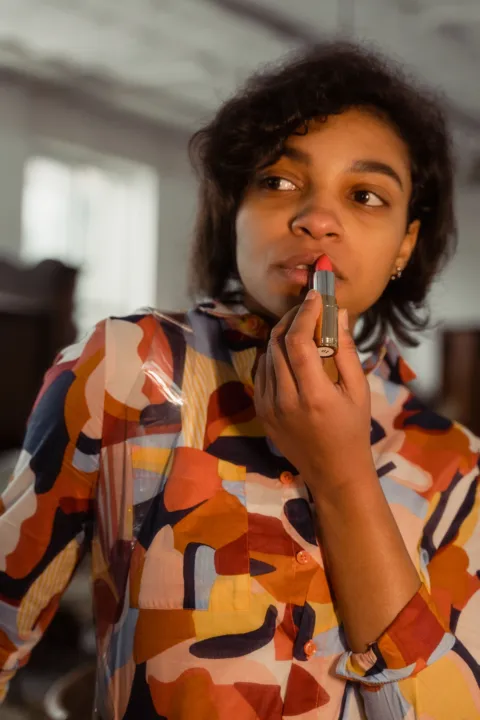
5. Lips
Put on a plain lip balm at the start of all this. By the time you reach lip color, it will have softened the surface, and you can blot off the excess.
Base products sit best on skin that is clean, comfortable and not coated in anything still wet.
Where primer fits
Primer is optional. If you like what one does for you, such as a smoother feel or a more matte surface, it goes on after sunscreen has settled and before foundation, in a thin layer and only where you want it. If your base already sits well, there is nothing a primer has to add.
What to skip
None of the following is forbidden. Each one either adds little before makeup or carries a specific risk on a day when you want your skin calm.
Scrubbing or exfoliating just beforehand
It is tempting to buff away flaky patches so foundation lies flat. The AAD’s advice is not to scrub, because it irritates the skin, and its moisturizer guidance warns against exfoliating dry, peeling skin in winter. Irritated skin tends to look redder and take makeup less evenly. Moisturize the dry area and give it a few minutes.
Anything new on an important day
The morning of an event is the worst time to try an unfamiliar mask, serum or primer. The AAD’s method for testing a product takes seven to ten days on a small area, for the good reason that reactions are not always immediate. Use what your skin already knows. The careful route is described in introducing a new skincare product.
A long stack of layers
Toner, essence, two serums, eye cream, moisturizer, oil, sunscreen, primer: each one leaves something on the skin. The AAD cautions that using too many products may irritate the skin, and from a makeup point of view, the more films you stack, the more likely they are to roll up when you blend foundation over them. That rolling is called pilling, and why makeup pills has a checklist for it.
Face oil or a very rich cream right before foundation
A slick surface makes base products slip and separate. If you enjoy oils or rich creams, the evening is an easier place for them.
Skipping moisturizer to control shine
The AAD’s guidance on oily skin is to moisturize after cleansing all the same, and to choose oil-free, non-comedogenic products. Its moisturizer guide adds that very oily areas may not need any. A light gel where your skin wants it is the middle path.
Skipping sunscreen because your foundation has SPF
The AAD notes that some cosmetics contain SPF, and that sun protection still has to be reapplied about every two hours outdoors. Makeup is rarely reapplied that way, so a dedicated sunscreen underneath remains the dependable layer.
Small adjustments
If your skin feels dry or tight: move up one texture, from lotion to cream, and allow longer for it to sink in. Choose a base with a creamy or liquid texture; powders tend to cling to dry patches.
If your skin gets shiny by midday: use a gel moisturizer, wait the full time after sunscreen, and blot once with a tissue before foundation. The AAD suggests that makeup labeled oil-free or matte can help with shine.
If you have five minutes in total: use a moisturizer with broad-spectrum SPF 30 or higher as a single step, brush your teeth while it settles, and go straight into a five-minute makeup routine.
If makeup still looks uneven: check the match before blaming the prep. A shade with the wrong undertone looks patchy however well the skin is prepared, and finding your foundation undertone is a quick check.
The short version
- Wash gently, pat dry. Lip balm on.
- Thin layer of moisturizer on damp skin.
- Broad-spectrum SPF 30+ sunscreen, full amount.
- Wait until skin no longer feels slippery.
- Primer only if you like it. Then makeup.
Sources
- American Academy of Dermatology Face washing 101
- American Academy of Dermatology How to pick the right moisturizer for your skin
- American Academy of Dermatology Should I apply my skin care products in a certain order?
- American Academy of Dermatology How to apply sunscreen
- American Academy of Dermatology How to control oily skin
- American Academy of Dermatology Sunscreen FAQs
- American Academy of Dermatology How to test skin care products
Researched and written by Dates Force Editorial with AI assistance, from the published sources listed above — not from product testing. This is general information about everyday cosmetic care, not medical advice. How we work · Report an error
Part of Getting Ready
Keep reading
Why Makeup Pills — and What to Check in Your Routine
Those little rolls of product usually come from layering, not from your skin. Seven checks to run, in order of how easy they are to test.