Why Makeup Pills — and What to Check in Your Routine
Those little rolls of product usually come from layering, not from your skin. Seven checks to run, in order of how easy they are to test.
You blend in your foundation and, instead of melting into the skin, it gathers into tiny gray rolls that look like eraser crumbs. That is pilling. It is one of the most common makeup frustrations and one of the most fixable, because it almost always comes from how products are layered and not from the skin itself.
What is happening, as far as anyone can say
A fair warning first. There is very little published, consumer-facing research on pilling, and we did not find an authoritative source that settles its causes. What follows is the explanation commonly given in cosmetic formulation, offered as a working model.
Many skincare and makeup products are designed to leave a thin film on the skin once they dry. Ingredients that contribute to that film include silicones, certain polymers and thickening gums. When a layer has not finished setting, or when there is more of it than the skin’s surface can hold, friction from the next step can lift the film and roll it up. The little balls are product, sometimes mixed with loose surface flakes of skin.
That model suggests the practical causes: too much product, too little time, too much rubbing, too many layers, or two formulas that do not sit well together. The checklist below goes through them in order of how easy they are to test.
The checklist
1. Are you using more than the layer can hold?
Check: does skin still feel coated or slippery a few minutes after applying serum or moisturizer?
Try: halve the amount of serum and moisturizer for a few days. Excess that never sinks in is the first thing to roll.
Sunscreen is the exception. Its protection depends on applying enough, so do not thin it out to prevent pilling. The American Academy of Dermatology’s guidance on how to apply sunscreen covers amounts. If the sunscreen is the layer that pills, change the formula or the products around it, not the quantity.
2. Is each layer getting time to set?
Check: are you applying the next product while the last one still feels wet or tacky?
Try: wait until the surface no longer feels slippery before moving on. For many products this is a minute or two. Brushing your teeth or getting dressed between sunscreen and foundation is an easy way to build the pause in. The AAD notes that sunscreen takes about 15 minutes to absorb, which gives a sense of the scale involved for that layer.
3. Are you rubbing?
Check: watch your hands. Back-and-forth rubbing or buffing in circles over layered products is the direct trigger.
Try: press and pat. Spread skincare in one direction with flat fingers, and apply foundation by tapping with fingertips or bouncing a damp sponge. A dense brush used in firm circles is the most likely tool to cause rolling.
4. How many layers are there?
Check: count everything between cleansing and foundation. Toner, essence, serum, second serum, moisturizer, sunscreen, primer is seven films before any makeup.
Try: cut to three: one treatment or serum, a moisturizer, a sunscreen. The AAD’s advice on the order of skincare follows that short sequence and adds that using too many products may irritate the skin. A pared-back morning is described in getting your skin ready for makeup.
5. Do two particular products disagree?
Check: does pilling happen only on days you use a certain serum, sunscreen or primer?
Try: the back-of-hand test. Apply your usual products to the back of your hand in the usual order with the usual waits, then rub lightly. If it pills, repeat on the other hand leaving one product out. Swap which product you omit until the rolling stops.
A commonly reported pattern is a thin, watery product applied over a rich, silicone-heavy one, or a silicone-based primer under a water-based foundation. It is not a firm rule, and plenty of such pairs work fine. If you want to look, silicones usually appear on ingredient lists as names ending in “-cone” or “-siloxane.” Reading the list is easier once you know how it is ordered; see how to read a moisturizer label.
6. Is powder going on before a cream?
Check: are you applying cream or liquid products over an area you have already powdered?
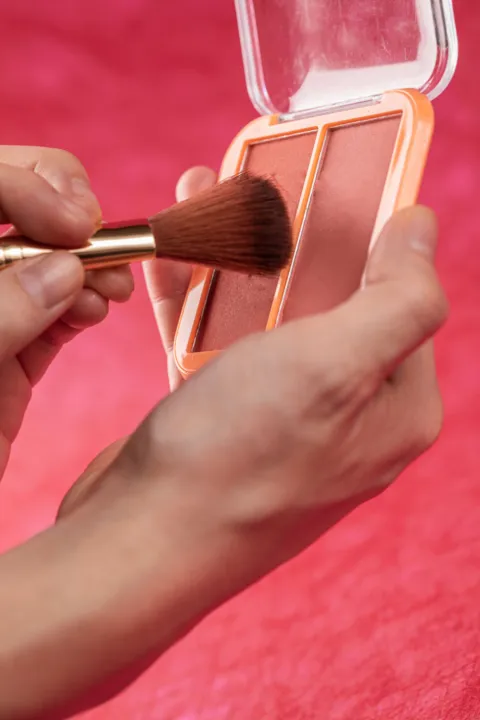
Try: finish all creams and liquids first, powders last. Cream blush or concealer worked over set powder is a classic way to lift the layer beneath. More on that order is in choosing between cream, liquid and powder blush.
7. Is there something on the skin before you start?
Check: does pilling happen mostly on dry, flaky areas, or on mornings after a heavy night cream?
Try: wash your face gently in the morning so you are not layering over residue. Resist scrubbing flaky areas to smooth them; the AAD’s face-washing guidance warns that scrubbing irritates the skin. A moisturizer given a few minutes to sink in does more for flaky patches than any exfoliating before makeup.
Change one thing at a time, or you will fix it without ever learning what fixed it.
How to run the checklist
Change one thing at a time, or you will fix it without ever learning what fixed it. A sensible order:
- Days 1–2: same products, but pat instead of rub and wait between layers. Technique solves a large share of cases without changing a single product.
- Days 3–4: reduce amounts of serum and moisturizer.
- Days 5–6: drop to three skincare layers.
- After that: use the back-of-hand test to find the product pair.
When it happens and you are already late
- Stop blending. More rubbing makes more rolls.
- Brush the pills away with a clean, dry, fluffy brush or a tissue, using light downward flicks.
- Press a damp sponge over the area to settle what remains.
- If a patch is bare, tap a small amount of foundation or concealer over it with a fingertip. Do not rub.
If the whole face has gone, removing everything and reapplying moisturizer, sunscreen and a light base with proper pauses is faster than repairing it.
Sources
- American Academy of Dermatology How to apply sunscreen
- American Academy of Dermatology Should I apply my skin care products in a certain order?
- American Academy of Dermatology Face washing 101
Researched and written by Dates Force Editorial with AI assistance, from the published sources listed above — not from product testing. This is general information about everyday cosmetic care, not medical advice. How we work · Report an error
Keep reading

Getting Your Skin Ready for Makeup Without Overdoing It
Cleanse, a thin layer of moisturizer, sunscreen, then wait. The short prep that helps makeup sit well, and the popular extras that can be skipped.