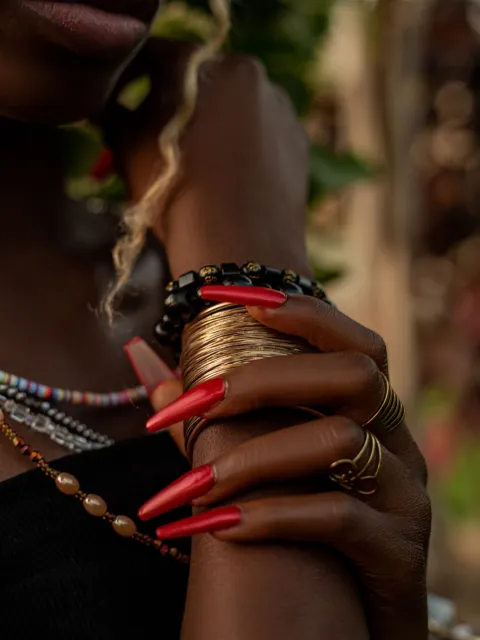
The invitation is on the fridge, the outfit is roughly decided, and at some point in the week before, the question arrives: what goes on the nails? There is no correct answer, but there is a quick way to reach yours. Work through four decisions in order, then check the result against the kind of event it is.
Decision 1: do you want your nails to lead or to support?
Everything else follows from this. Nails can be a feature of the look, like a bold earring, or part of the background, like good tailoring.
- Support: sheer pinks and beiges, milky whites, soft neutrals close to your skin tone, a clear gloss. These go with any outfit, and they suit events where you would prefer attention on your face or on what you are saying.
- Lead: a saturated red, a deep berry or plum, navy, emerald, a bright coral, a metallic. One strong nail color can be the whole accessory plan for a plain outfit.
If the outfit is already busy, with print, sequins or strong color, a supporting nail usually sits better. If the outfit is simple, either works.
Decision 2: match, echo or contrast?
Three ways to relate nail color to what you are wearing:
- Match. The same color family as the outfit, a little lighter or deeper. Tonal and quiet. An exact match can look flat, so aim for a shade or two away.
- Echo. Pick up a small color from somewhere else: a print, a shoe, a bag, your lipstick, your jewelry. This is the most reliable route to looking put together, because the nails repeat something instead of adding something.
- Contrast. A color opposite in mood to the outfit: red with navy, deep green with blush, black with white. Confident, and best when the nails are the only contrasting element.
Metal counts too. Warm-toned polish (corals, brick reds, caramels) sits easily beside gold jewelry; cool tones (blue-reds, mauves, grays) beside silver. That is a convention, not a rule, and mixed metals mix with anything.
If you are planning a statement lip, decide whether nails and lips will agree or whether one will stay neutral. Our piece on one red lip worn three ways shows how much a single red changes with its surroundings, and the same holds for a red nail.
Decision 3: which finish?
Finish changes how a color behaves in the light of the event.
- Cream gives true, solid color and looks crisp in daylight and photographs.
- Sheer looks fresh and natural, and hides chips and growth, which matters for multi-day events.
- Shimmer or metallic comes alive under evening and artificial lighting and is forgiving of wear.
The full comparison is in our guide to sheer, cream and shimmer finishes.
Decision 4: what do your hands have to do?
The practical check. Ask how long the manicure has to last, and what it will go through.
- One evening: anything goes, including a dark cream, the least forgiving choice.
- A weekend or a trip: sheers, fine shimmers and mid-tone neutrals wear most quietly. Pack the bottle for touch-ups if you choose a strong color.
- Hands on show: if you will be shaking hands, holding a glass, signing something or wearing a ring that will be photographed, tidy edges matter more than the color. Paint the day before, not the hour before, so the polish has fully hardened.
- Hands at work: cooking for guests, carrying equipment, wrangling children. Choose short and sheer.
Nails can be a feature of the look, like a bold earring, or part of the background, like good tailoring.
By occasion
Starting points, not instructions. Adjust for your own taste and any dress code.
| Occasion | Reliable choice | If you want more | Worth knowing |
|---|---|---|---|
| Wedding guest | Soft pink, peach, mauve or a milky sheer | A color echoed from your outfit or accessories | Long day, many photos, lots of handshakes: favor a finish that wears well |
| Your own wedding or a formal ceremony | Sheer pink or beige, micro French | A classic red or a soft shimmer | Close-up photographs of hands are likely; do a trial a week or two ahead |
| Job interview or presentation | Clear gloss, sheer neutral, or a muted cream | A deep, quiet shade such as burgundy or navy, on short nails | A neat, chip-free finish reads better than any particular color |
| Evening party | Deep red, berry, plum or navy | Metallic, glitter accent or black | Low light flatters dark shades and shimmer |
| Dinner out | A classic red or a rich neutral | Whatever echoes your lipstick | Hands are on the table and in view all evening |
| Daytime celebration, garden party, brunch | Coral, rose, soft pastel, sheer | A bright cream | Natural light shows true color and every streak; use thin coats |
| Beach or holiday | Bright coral, turquoise, sheer shimmer | A different color on the toes | Sun, sand and water are hard on polish; bring the bottle |
| Graduation, family gathering, religious occasion | Soft neutral or classic mid-tone pink | A tonal accent nail | Check whether the occasion or venue has expectations about dress |
Skin tone: a light touch
Any color can be worn on any skin tone. What changes is the effect. A shade close to your own skin tone blends and makes the fingers read as one long line; a shade far from it stands out as a block of color. Neither is better.
Within one color, the undertone is what makes a shade feel easy or slightly off. A red can lean orange (warm) or blue (cool); a nude can lean peach, pink or beige. If a color looks dull or harsh on your hand, try the same color with the opposite lean before giving up on it. The method in our guide to finding your foundation undertone works for hands too.
The surest test is a direct one: paint a single nail, or a strip of clear tape stuck to a nail, and look at it in daylight and in evening light next to the outfit.
Timing and practicalities
- Test a new shade a week ahead. Colors look different on the nail than in the bottle, and you find out how many coats it takes.
- Paint the day before. Polish that feels dry can still dent for hours.
- Use extra base coat under strong reds and oranges. The American Academy of Dermatology recommends an additional layer of base coat before bright red or orange polish to protect against discoloration, which is useful if you plan to switch to a sheer afterward.
- Carry the bottle, or at least a clear top coat, for a strong color at a long event.
- Do not try a new product type for the first time the night before. If you want length or a design for the day, wear a trial set earlier in the month; our guide to press-on nails covers fit and removal.
The short version
- Lead or support?
- Match, echo or contrast with what you are wearing?
- Cream, sheer or shimmer for the lighting?
- How long must it last, and what will your hands be doing?
Four answers, and the choice has usually made itself.
Sources
- American Academy of Dermatology Manicure and pedicure safety
Researched and written by Dates Force Editorial with AI assistance, from the published sources listed above — not from product testing. This is general information about everyday cosmetic care, not medical advice. How we work · Report an error
Part of Getting Ready
Keep reading
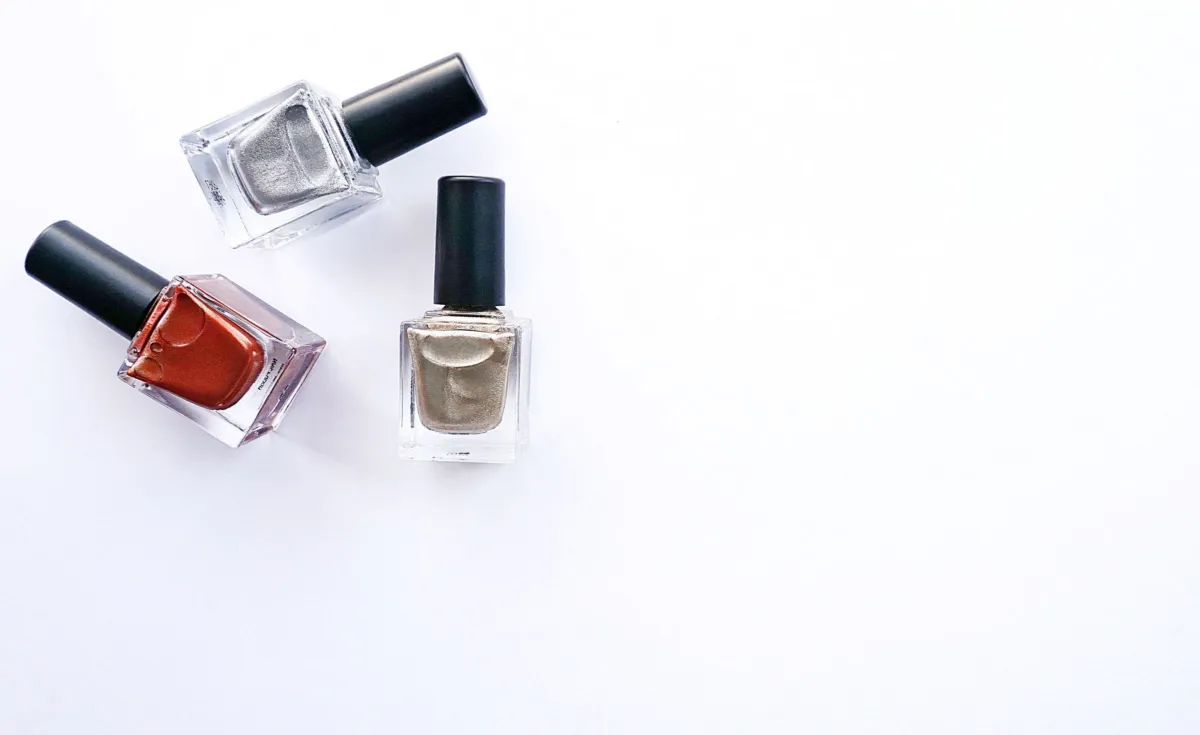
Sheer, Cream or Shimmer: A Guide to Polish Finishes
The same shade behaves differently as a sheer, a cream or a shimmer. How each finish applies, wears and grows out, and when to reach for it.