How to Refresh Your Makeup Without Starting Over
Midday touch-ups work best when you take away before you add. Find what you see in the mirror, from shine to smudges, and fix only that.

The mid-afternoon mirror check tends to end the same way: more powder, more concealer, more lipstick, all on top of what is already there. An hour later it looks heavier and no fresher. A refresh works the other way around. Take away what has gone wrong first, then add back the smallest amount that solves it.
The sections below are organized by what you see in the mirror, so you can go straight to the one that applies.
Before anything: clean hands
Every fix here involves touching your face, and by mid-afternoon your hands have been on doors, keyboards and phones. Wash them or use sanitizer and let it dry. The American Academy of Dermatology’s advice on oily skin is to touch your face only when cleansing, moisturizing or applying sunscreen or makeup, with clean hands. The FDA says the same about hands before applying eye cosmetics.
If you see shine
Remove: press a blotting paper, or a single ply of clean tissue, against the forehead, the sides of the nose and the chin. Hold it there for a couple of seconds and lift. The AAD’s guidance is specific on this: press gently and do not rub, because rubbing spreads the oil around. Rubbing also takes the foundation with it.
Add: often nothing. Blotting alone brings most bases back. If shine returns quickly, press a small amount of powder onto those same zones with a puff. Pressing sets; sweeping moves makeup that has already softened.
If the base has gathered or separated
This shows up around the nostrils, in smile lines and on the chin, where the face moves most.
Remove: blot first. Then use a clean fingertip, or a sponge that is barely damp, to tap over the area. The aim is to spread what has collected back into a thin layer. No new product is involved at this stage.
Add: if skin shows through, a pinhead of concealer tapped over the gap. Blend the edge only.
If concealer has creased under the eyes
Remove: look up into the mirror and tap along the crease with a ring finger. Body warmth softens the product and the tapping smooths it flat again.
Add: usually nothing. If the area looks dry and textured, powder will make it worse. A trace of eye cream or plain moisturizer pressed over the top often revives it better. If it looks slick, a very light press of powder will hold the repair.
If eye makeup has traveled
Remove: for mascara dots or liner that has drifted below the lower lashes, roll a cotton swab under the eye. A dry swab handles fresh smudges. For set ones, touch the tip of the swab to a little moisturizer or makeup remover first. Roll it rather than dragging, so it lifts the smudge and leaves the concealer.
Add: tap the concealer back over the spot if the swab took it off. Leave the mascara alone; a fresh coat over dried mascara is how clumps form.
If color has faded
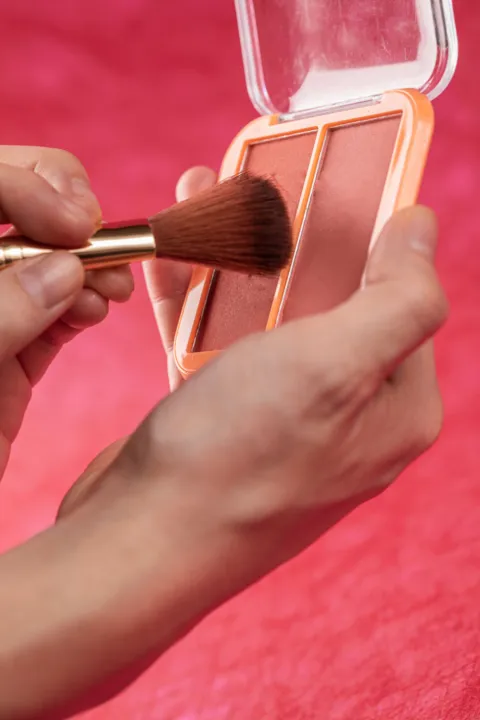
Cheeks: a cream or stick blush can be tapped on with a fingertip over existing makeup, as long as the base underneath is not heavily powdered. Over a powdered base, use powder blush instead. The reasoning is in this comparison of cream, liquid and powder blush.
Lips: take off the remains before reapplying. A ring of color at the edges with a bare center will not be fixed by a new coat on top. Wipe with a tissue, apply a little balm, blot, then reapply. One lipstick can also be worn at different strengths through the day, as in one red lip, three different looks.
If skin looks dry or flaky under makeup
Remove: nothing. Do not pick at flakes or scrub them.
Add: warm a very small amount of moisturizer or balm between two fingertips and press it over the patch. Pressing lays the flakes down and brings back some flexibility. Skip powder on that area for the rest of the day.
When layers start rolling into little balls as you touch them up, stop adding. That is pilling, and more product feeds it. The causes are covered in why makeup pills.
If you are spending the afternoon outdoors
This is the one situation where the makeup comes second. The AAD’s sunscreen guidance is to reapply every two hours outdoors, and straight after swimming or sweating. Makeup with SPF does not change that; the AAD notes that cosmetics containing SPF still have to be reapplied on the same schedule.
In practice, that means accepting a lighter, simpler base on long outdoor days: reapply sunscreen, let it settle, then touch up with concealer and a little color where you want it. Shade and a hat reduce how much you are relying on the sunscreen in the first place.
Take away what has gone wrong first, then add back the smallest amount that solves it.
The refresh kit
Everything above uses six small things:
- Blotting papers or a pack of tissues
- Cotton swabs
- A concealer
- A pressed powder with a clean puff
- A cream blush or a lipstick that can double as one
- Lip balm
They fit in a pouch the size of a hand, and the logic for each is laid out in what belongs in a small, useful makeup bag.
When starting over is the better call
Occasionally a refresh is not worth it. If you have been caught in rain, been swimming, or cried enough that the base has broken up across the whole face, patching takes longer than removing everything, moisturizing and reapplying a light base. The same goes for the moment after a workout: cleanse first, then start fresh with as little as you like.
Sources
- American Academy of Dermatology How to control oily skin
- U.S. Food and Drug Administration Eye Cosmetic Safety
- American Academy of Dermatology How to apply sunscreen
- American Academy of Dermatology Sunscreen FAQs
Researched and written by Dates Force Editorial with AI assistance, from the published sources listed above — not from product testing. This is general information about everyday cosmetic care, not medical advice. How we work · Report an error
Part of Five-Minute Fix
Keep reading

What Belongs in a Small, Useful Makeup Bag
A handbag makeup kit is for repairs, not a second application. Eight items that earn the space, what stays home, and how to keep it all clean.